Showing posts with label essay. Show all posts

Essay: Karla Siegel Paintings at Artspace Liberti

 
Untitled, 2011, Karla Siegel


Below is an essay I was commissioned to write for friend and fellow studio mate, Karla Siegel. The show just opened up this past Friday; please go see it and support not only her work but Artspace Liberti in Fishtown. I think this is some of the best stuff I've written recently...


It's a matter of belief then. Do you believe that what this picture is showing you is true; that it truly exists or once existed? Do you believe that the artist is being sincere in their motive, approach, and depiction? When light, which is a major problem (in the sense of an experiment or challenge) in Karla Siegel's work is invited, even encouraged, to have its way, the question must be asked: what do you believe? It's probably too philosophical a beginning for most of us, but nevertheless underlying all vision lies the question of belief. And when an artist such as Siegel, doubly a painter, invites light into the mix as powerfully as she has, the questions crop up.
    Light makes painting not only beautiful, but also confusing; it imparts order as well as chaos. Take an example from art history; say, Impressionism. This movement was brief as far as movements go, but at its heart it was interested in the same thing painting has been interested in all along: the capturing of an essence. Impressionist painters went about it by, as some critics spit at the time, "flinging” their paint-pots at canvas. Despite the ironclad acceptance now of Impressionism, these critics were not far from the truth. These painters – Monet, Pissarro, et al – were often working so ardently to capture and encapsulate the play of light creating and destroying form, they nearly were flinging paint in their zeal to stop light and time in their tracks. (Of course flinging with intent, and without, makes all the difference here). Monet, for example, was so doggedly after the enigma of light, that he did several scenes – one of the most haunting and well-known being the haystacks – over and over, in this light and that, one day after the other. Siegel's painting is rooted directly in the traditions of painting: she says as much herself. Portraiture and still-life are the two expressions of painting that are most obvious here. But, as mentioned before, she is most deeply rooted in the more primal – more human, you might even say – painterly instinct, that of pursuing and subduing the essential element of light. But how exactly – and how does Siegel call us to belief through her paint?
    One method is layering. Time and light have been companions throughout the history of art – one example has been mentioned already. In some cases, the artist attempts to stop time, or at least express the effect of a set time period of light upon paint. In other cases, time is less linear and more layered, something like the difference between a cupcake and a layer cake. The former is heat, time and materials all running parallel in one take; the latter is again the product of heat, time and materials running the same way, but then separated and stacked to create an entirely different result – and reaction. Siegel's portraits are the layer cake: we see different time + light creations piled or layered upon each other. And the technique and perspective reiterate this: in several paintings the face comes up close, very close to the painting surface, becoming muddled and thick in its execution; in others the outlines of shoulder, neck, and head are recognizable, but they are cut from the up-close detail of another face, like a small profile snipped out of a larger image from a magazine. Another of the portraits has a pulled effect, not unlike taffy, that moves the figure up into the blocks of light suggesting a large studio window. The figure, though owing a bit to Bacon, is more calm than his tortured, drawn figures. Even here though, one intuitively picks up on the layers of reaction to light that Siegel has percieved, and subsequently sandwiched into the picture.    
    A second tactic of Siegel's to subduing the enigma of light can be seen in her still-life-inspired abstracts, which suggest not only fountains, bouquets and blooms; but also driveway fireworks and bright, smoky explosions. Earlier mention was made of the action of light through paint at times creating confusion or chaos. In the still-lifes, Siegel is not actually trying to confuse or unsettle the viewer; rather she, like any good artist or scientist, is attempting to solve a problem – and here one problem is fresh depiction. And the approach chosen is to de-clarify; to make indistinct; to obfuscate. But why? One cannot really know; often even the artist can't articulate their own reasoning. Here's a shot, however: consider the full-on, noonday sun. It is blazing; crippling; impossible to look upon fully without pain and damage. If one made an attempt to do so, it would literally blind you – just as omniscience would implode our understanding. In other words, humans are incapable of the full absorption of light's power; of full absorption of worldly knowledge – we are too corporeal. But...what of those hazy and foggy days when the sun is obscured; covered by a scrim of moisture, smoke or steam? Now, the sun – the full sun – can be gazed upon with no damage! Its spherical contour can be made out through the haze – one element of the sun's existence does not escape us. In the case of Siegel's still-lifes, the full knowledge of the scene or source would not actually be physically injurious to us – from human to human, pure knowledge and vision do not function that way. However, without Siegel's haze of paint; scrim of manipulation; we would be stymied by too much – too much information; too much direct representation – we'd not be asked to do any work. As with the full-on sun, we'd be blinded by our own visual callousness. But through obfuscation and haziness, Siegel tells us less, and the painting teaches us more. And as with the hazy sun, one element at least does not escape us. This is the part of the basic paradox of art that Siegel so adeptly and consistently dips into.
    Finally, Siegel captures light by doing exactly that: collecting it, largely in the impasto of her portraits, but also more subtly in the delicate washes and glazes in the still-life abstracts. This occurrence came while looking at them closely: the impasto, lain horizontally, vertically, diagonally this way and that, captures, gathers, and intensifies the cast light from sources both natural and artificial, much like a screen or colander captures grit or grains on its grid, creating independent patterns and intensifying the light's power in particular areas, as well as modulating the surrounding and underlying colors. This uncovers an approach to the original question of belief: this collecting and emitting of light –as nearly physical as is possible without a filament or diode – underlines emphatically the base materiality of the work. Thus an utterly material attribute of the painting – the impasto paint with its furrows, hills and dales – is capturing and enlarging the effect of a highly immaterial entity: light. Here is where the enigmas might clash. But because of this sudden kiss of the material and immaterial, we find ourselves able to answer to a point, perhaps timorously, perhaps boldly: "I believe – but help me with my unbelief!"

Timothy Gierschick
January, 2012

Read more...

Art Thoughts, Week 46: David & Conflict


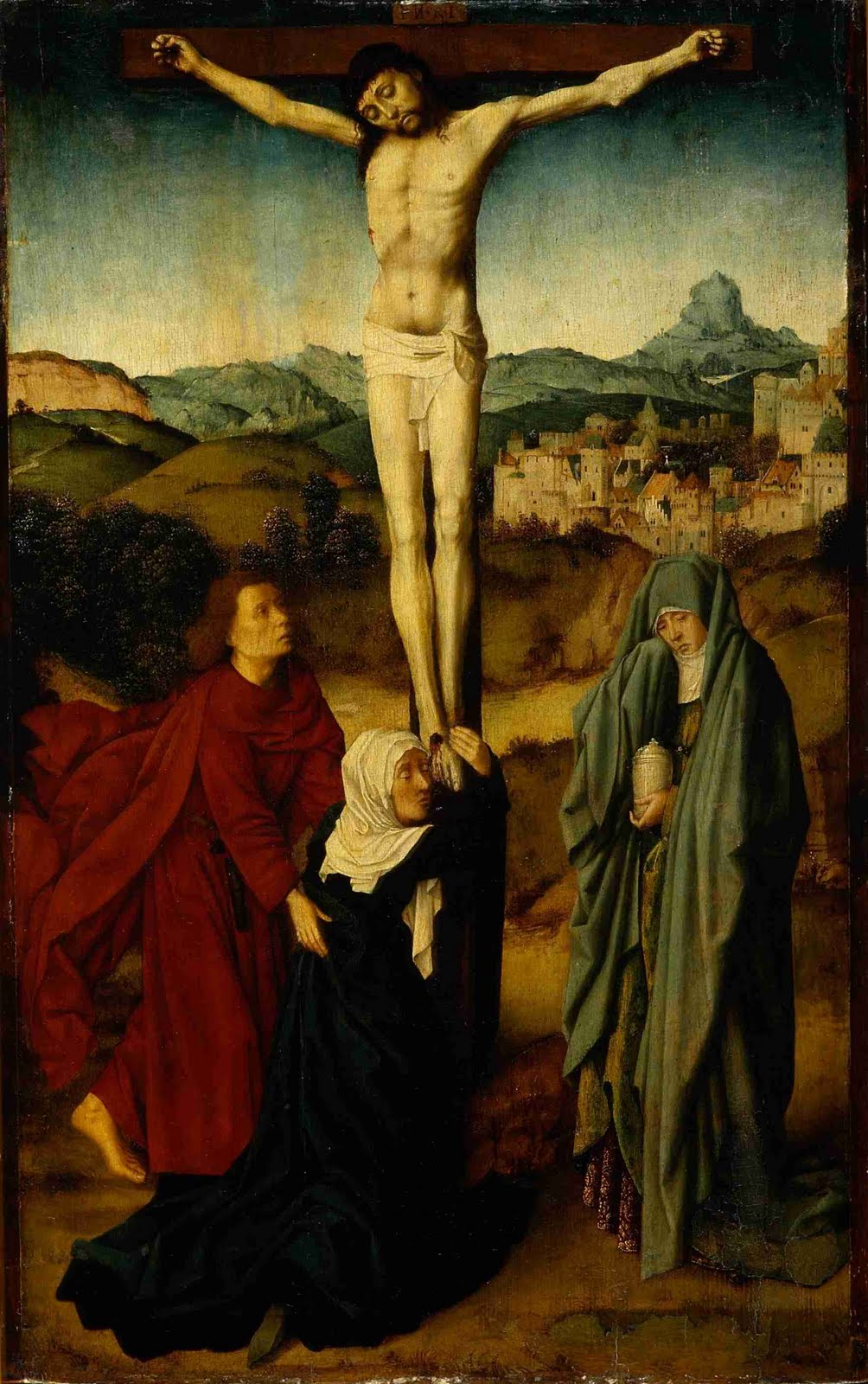
Crucifixion Scene with the Virgin, St. John and the Magdalene, Gerard David, Netherlandish (1460—1523), oil on panel, BF123.

Even when writing about paintings, auto-pilot can attempt to take over. Whether through routine, boredom, distraction or stereotypes, occasionally the same words, the same thoughts, the same associations float to the top. For this particular painting, Crucifixion by David (pronounced Dah-veed), that particular temptation to be rote came from genre. This is firstly a religious painting, and secondly a crucifixion: a genre so ubiquitous as to elicit a whole corral of pre-programmed expectations. Ironically, my sculpture professor used to say the hardest thing to depict seriously in art is the cross: it’s just been done too many times, and too often poorly. But even though this happens, one must keep looking, and keep writing. 

The important question which finally emerges is what is there about this painting’s unique voice which helps it rise above the babble? By what aspect does this piece distinguish itself? Though an academician, and subject to the whims of his patrons, David was nonetheless his own person, and most importantly his own painter. Otherwise (to grow momentarily snarky) how would one know if it was a Van der Weyden, Tintoretto or Gaugin crucifixion that we were looking at? You get the point: aesthetic signature is important; primary, even.

But what else – any particular emotional undercurrent which pulls or pushes the painting in one direction or another? There is such within this painting, animating it…and there is a companion set of color choices by David (supported by convention) which set up both a support and a denial of that emotional portrayal. In other words, the painting’s components take sides. Another professor of mine, this time in literature, stated that all fiction, at its core, has a driving force of conflict behind it. It is a raw touchstone for humanness. And really, what more conflicted scene could one imagine for a 15th century Christian? They, along with the figures here, are stuck between a promise and a reality. That is, the promise of resurrection and renewal, and the harsh reality of an expiring fleshly form.

To illustrate the basic conflict, look at two of the figures. The emotional conflict is primarily represented in the central figure, Mary the mother of Jesus. (Mary Magdalene, the third in the group, is sometimes shown at the foot of the cross, but the scriptural reference supports this being the Virgin, since John is comforting her). Not only is her entire gesture and weight attempting to hold Jesus down, but also the darkest colors in the painting are found in her cloak, causing the greatest balance of weight – compositionally and emotionally – to be on her side. And this makes sense: it is before the resurrection, when reality holds sway. Her emotional response of wrapping around the cross and Jesus’ feet and holding on for dear life, accentuates the necessity of Christ’s eventual ascent – here signified iconically by his outstretched arms, seeming like not so much a crucifixion as an attempt to fly up into the air, right then and there.

John the disciple, the figure on the left, is opposed to Mary emotionally and by color. He rushes in (by evidence of his flying, flaming cloak) and comforts Mary with the promise aspect of the equation –while likely being unconvinced of its verity. With his shocking crimson coat, he represents the passion with which he takes up the duty of looking after Jesus’ mother Mary…despite the doubt; he shows why he is the “disciple whom Jesus loved”: he is devoted despite overt emotion.

Mary Magdalene represents, I believe, the place where most viewers will (and should) find themselves (knowing, after all, how the story ends): at the place of sorrowful readiness. She has a vessel which most likely holds the embalming spices for the burial. That is, she is neither pinioning the promise like Mary, nor bemoaning the reality like John…she is rather, prepared to move on and step into the future, regardless of what the details may determine. She remains, after everything, that belittled – but far from little – giant of faith.

Read more...

Art Thoughts, Week 44 -- De Chirico and Collecting

Charles Willson Peale, The Artist in his Museum, 1822.


Giorgio de Chirico, Sophocles and Euripides, 1925 (BF575).

NB: Since the class is winding down, my thoughts have returned to my unfinished project, 52 weeks of Art Thoughts; begun (believe it or not) January of 2008. SO, I wrote number 44/52 this week, not realizing until I'd written most of it, that I'd already done a piece on De Chirico. Ah well, "no hahm, no fow-el." Enjoy, and look for more of these throughout the rest of December and January.

Sophocles and Euripides, Giorgio de Chirico (Italian, 1888—1978), 1925, oil on canvas, BF575.

Collecting things – almost anything – seems to be an impulse common to the majority of humans. Amassing like things, according to particular definitions, criteria or guidelines, somehow finds constant purchase in the ridges of our brains, and tickles our fingertips. Charles Willson Peale, being a late-18th century artist of the highest order, as well as a thoroughly late 18th century man, had a bit of the nascent Wunderkammer bug about him. It wasn’t merely exoticism which drew him, though – a wealth of skeletons, artifacts and natural specimens was simultaneously a trove of painting and study props. Therefore not only was it zeitgeist, it was utilitarian – and undoubtedly a function of his delight. Consider The Artist in his Museum, a self-portrait of 1822 – with obvious pride and flourishing of demure delight, he offers us entrance. It is that held curtain, the pulling back of an obstacle to entrance (a symbol of imparted revelation), which connected me to Peale from de Chirico’s Sophocles and Euripides

Here too, there is an implied slip of dark curtain on the right-hand side – though hardly enough to impede. Yet, there it is. De Chirico is thus inviting us into a strange and confused space – but unlike Peale’s space, this one by its nature is un-categorical. The figures, named after two ancient Greek thinkers, dominate centrally. And like many philosopher’s arguments, as well as many de Chirico figures, one is not sure whether the figure and concept is meant to seem solidified, or still animated – or somewhere in between? At the figures’ hearts, there is a sudden colorful blossoming of thought-form: inspiration that is fleeting; bright; and slippery. Tools are here to grapple with it – yet we wonder whether the hemlock has yet reached their hearts. De Chirico’s brush strokes seem to accentuate this psychological tentativeness: each stroke is a word in this narrative; compiled, they construct an illustrative picture. The assembled formal aspects create a narrative; though, like the brightly-colored shapes in the chests and backs of the figures, we are far more unsure of their purpose than we are of their form. What we might notice, though, is that the area of “thought-forms” is the most vibrant, free-form thing about this space. The buildings and space around them, even the figures, are as bright and vacuous as the common person’s stereotype of heaven. Additionally, the part of the body most often associated with this vivid flowering of thought, the head, is a dressmaker’s dummy head: a form only, stuffed with dumb filler, used only to imply a basic sense of humanness. The Greeks believed the bowels to be the seat of human emotion; perhaps the center of human thought for them was the heart?

Collecting thoughts rather than artifacts, these philosophers calmly gesture on in their evanescent and rarified scene – the most tentative and sketchy area of the already-tentatively painted surface. But how colorful and eye-catching their mental constructions are – there is obviously more thought spent on the interior collecting of thoughts, than on the world around them. Perhaps this really is their true purpose – but how much truth there is in this: the more appealing and grandiose our interiors become, the more hardened our external efforts may grow. Dostoevsky gave form to this idea when his Underground Man excoriated the current philosophers by “quoting” them as saying, “Everything is beautiful and lofty,” at the same moment their feet tread squalor.

Read more...

N4TUR3 essay

(above, from Tiger Strikes Asteroid's Facebook page; l to r: Thomas Vance, Misako Inaoka, Regin Igloria)


Here for interested parties, is an essay I wrote to accompany my gallery's latest exhibit, N4TUR3. To see images from the exhibit, go to www.tigerstrikesasteroid.com, or come see the exhibit up through June 26th.


N4TUR3 essay


Sometimes, nature is considered a mirror for humans; a place to see ourselves reflected – for better or for worse. In N4TUR3, this creates a visual paradox: we are both nowhere and everywhere in these works.

David Guinn’s Snowy Owl is a quiet avian portrait, but in the background snowpack we see the path of a recently-passed – but now disappeared – human. In Igloria’s Entanglement in Orange the human presence is clearly expressed in the manufactured product of a fluorescent-orange snow fence, holding a mass of foliage in a deathly embrace. The fence, an epitome of uniformity, is blaringly obvious in that un-natural state, but there is no other evidence of the humans that have made, and left, it. It is simply carrying out its naïve fate like a wind-up toy left to its own devices. And for Beth Brandon, the absentee human leaves behind an even more dynamic effect. In her two drawings, there is a before-and-after pattern of fire and smoke, but still no human (who we may assume has cut down the trees and struck the match).

Thomas Vance’s Cornice involves a more snarled evidence of this dubious human influence. Not simply a mostly-unaltered landscape on which human touch has left an obvious mark, such as in Snowy Owl, it is unclear from which direction Cornice has come from, or is going. In other words, is this an object which has been constructed to mimic nature? Or was it once a tree (Cornus, after all, is the Latin name for the dogwood family) but has now metamorphosed into a idealized tree-form; simply a product made from it’s model’s material, much like those toilet-paper roll trees from elementary school. While most of the other works are either on one side or the other of nature or artifice, Cornice is on the fence. Indeed, it is the fence for this N4TUR3.

Cornice embodies the question, and becomes the possible answer for the issues raised in N4TUR3: no matter its source or direction, a certain beauty is reached. In fact, in all these pieces, the results of human touch, whether the intent was good or bad, is always beautiful. Entanglement in Orange; Red Berries/Red Bird; The Need-Fire: every one is twisted, but twisted into beauty. Therein lies the possible answer, pointed out to us by art, but it should not distract us from the question, which will keep reappearing as long as we fiddle with nature the way we tend to: gene splicing; bio-engineering; rampant resource exploitation; drilling and scraping and poking. What we forget at our peril is that whatever we do to nature, we do to ourselves. The mirror always tells the truth.


- P. Timothy Gierschick II


Read more...
Related Posts with Thumbnails