Showing posts with label David. Show all posts

Art Thoughts, Week 46: David & Conflict
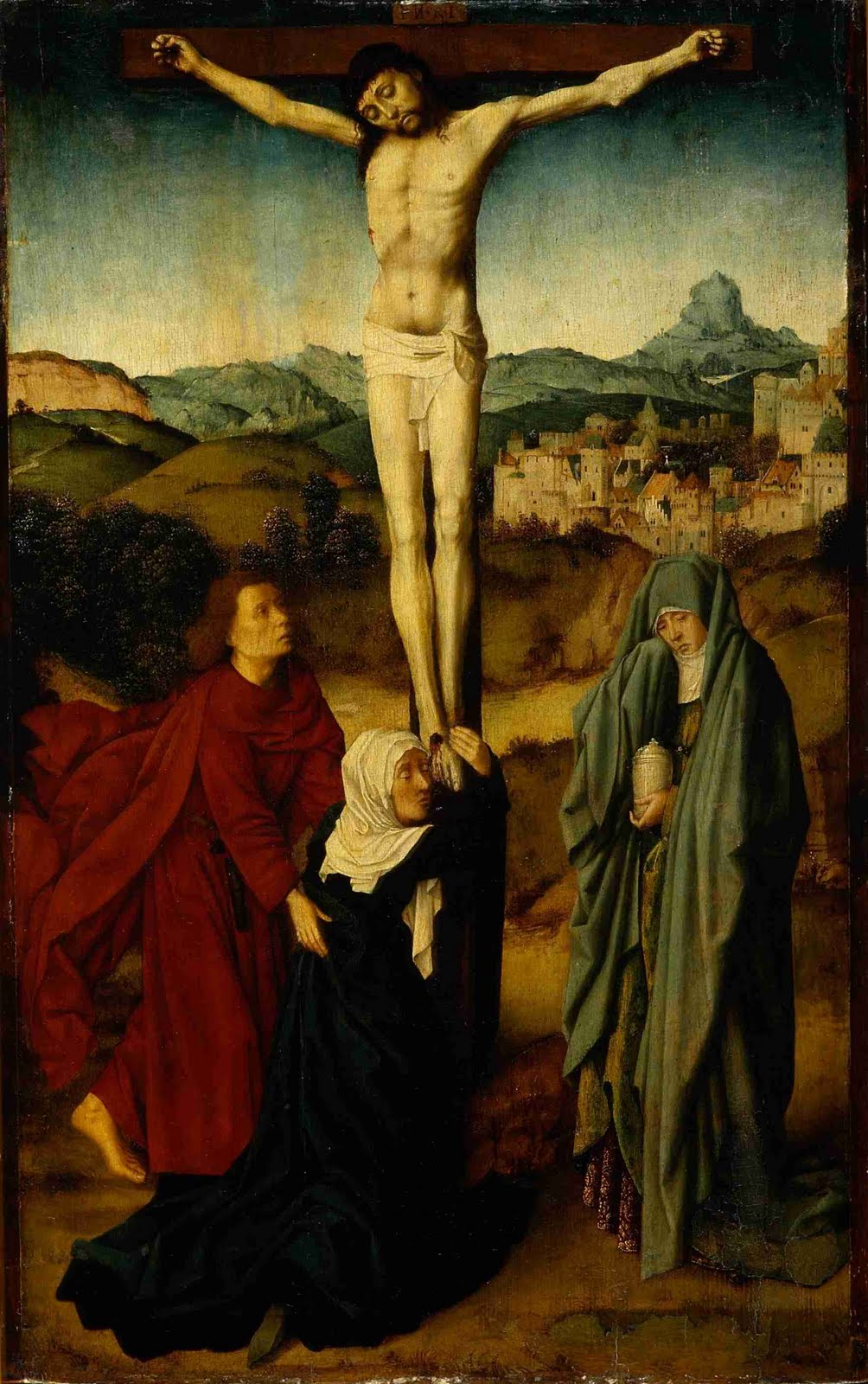

Crucifixion Scene with the Virgin, St. John and the Magdalene, Gerard David, Netherlandish (1460—1523), oil on panel, BF123.

Even when writing about paintings, auto-pilot can attempt to take over. Whether through routine, boredom, distraction or stereotypes, occasionally the same words, the same thoughts, the same associations float to the top. For this particular painting, Crucifixion by David (pronounced Dah-veed), that particular temptation to be rote came from genre. This is firstly a religious painting, and secondly a crucifixion: a genre so ubiquitous as to elicit a whole corral of pre-programmed expectations. Ironically, my sculpture professor used to say the hardest thing to depict seriously in art is the cross: it’s just been done too many times, and too often poorly. But even though this happens, one must keep looking, and keep writing. 

The important question which finally emerges is what is there about this painting’s unique voice which helps it rise above the babble? By what aspect does this piece distinguish itself? Though an academician, and subject to the whims of his patrons, David was nonetheless his own person, and most importantly his own painter. Otherwise (to grow momentarily snarky) how would one know if it was a Van der Weyden, Tintoretto or Gaugin crucifixion that we were looking at? You get the point: aesthetic signature is important; primary, even.

But what else – any particular emotional undercurrent which pulls or pushes the painting in one direction or another? There is such within this painting, animating it…and there is a companion set of color choices by David (supported by convention) which set up both a support and a denial of that emotional portrayal. In other words, the painting’s components take sides. Another professor of mine, this time in literature, stated that all fiction, at its core, has a driving force of conflict behind it. It is a raw touchstone for humanness. And really, what more conflicted scene could one imagine for a 15th century Christian? They, along with the figures here, are stuck between a promise and a reality. That is, the promise of resurrection and renewal, and the harsh reality of an expiring fleshly form.

To illustrate the basic conflict, look at two of the figures. The emotional conflict is primarily represented in the central figure, Mary the mother of Jesus. (Mary Magdalene, the third in the group, is sometimes shown at the foot of the cross, but the scriptural reference supports this being the Virgin, since John is comforting her). Not only is her entire gesture and weight attempting to hold Jesus down, but also the darkest colors in the painting are found in her cloak, causing the greatest balance of weight – compositionally and emotionally – to be on her side. And this makes sense: it is before the resurrection, when reality holds sway. Her emotional response of wrapping around the cross and Jesus’ feet and holding on for dear life, accentuates the necessity of Christ’s eventual ascent – here signified iconically by his outstretched arms, seeming like not so much a crucifixion as an attempt to fly up into the air, right then and there.

John the disciple, the figure on the left, is opposed to Mary emotionally and by color. He rushes in (by evidence of his flying, flaming cloak) and comforts Mary with the promise aspect of the equation –while likely being unconvinced of its verity. With his shocking crimson coat, he represents the passion with which he takes up the duty of looking after Jesus’ mother Mary…despite the doubt; he shows why he is the “disciple whom Jesus loved”: he is devoted despite overt emotion.

Mary Magdalene represents, I believe, the place where most viewers will (and should) find themselves (knowing, after all, how the story ends): at the place of sorrowful readiness. She has a vessel which most likely holds the embalming spices for the burial. That is, she is neither pinioning the promise like Mary, nor bemoaning the reality like John…she is rather, prepared to move on and step into the future, regardless of what the details may determine. She remains, after everything, that belittled – but far from little – giant of faith.

Read more...

Art Thoughts 2009!


No, I haven't forgotten about my promise last year, around this time, to do a weekly mini-essay on an artwork at the Barnes Foundation...called Art Thoughts. Though many weeks were really tough on my discipline, I did finally get to number 36, and I plan on plugging away on this project in the new year, until it is done (week 52: the equivalent of a year's worth of weekly essays).

So, next up is my reflections on one of the Toulouse-Lautrec paintings here at the Foundation: enjoy! I will have it up by Friday, early-afternoon at the latest.

After this project is finished (probably by mid-March), I hope to begin another series of these miniature art-essays. If anyone has read these, and thought, "I wish he'd write about ____", or "I wonder if he's ever thought of ____", please send those ideas my way, and I will consider them.

As the series went on, I realized how much I was becoming interested in how what I was seeing at the Foundation resonates with much older artwork, and conversely, more contemporary artwork (for example, the Jacques-Louis David + Bonnard, and the Vuillard + James Castle). This might be a focus of a new series. It's hard to not use such an immediate source as that right outside my office door!

In other arenas, I made some informal resolutions with myself this new year: firstly, to pursue my small business ideas; and secondly, to pursue my artwork with more gusto and determination, becoming more assertively and boldly self-promotional. I've heard too many stories, yes even in Philly, of artists who simply befriend gallery and arts professionals, talk about and ask for a project or show, and end up getting it...seems they've learned the lesson of "ask, and it shall be given you" more quickly than I have.

Additionally, I hope to be more resolute in my posting updated pictures of current work in the studio. For now, I just updated (slightly) my website www.gierschickwork.com with some new images and news items, so go and check that out.

Here's to success in 2009! >clink<

Read more...

Art Thoughts, Week 34 -- Bonnard & Writing


Young Woman Writing, Pierre Bonnard (French, 1867—1947), 1908, oil on canvas, BF 367.

Letter writing, a daily discipline for several generations, is today largely dead. Done in by email, instant messaging and other more immediate methods of communicating, it is a mode of crafting a connected intimacy that has not found a satisfactory replacement. In Young Woman Writing, Bonnard captured a woman in the midst of her various correspondences. And being the painter, often, of carefully considered interiors (much like his friend and fellow Nabis, Vuillard) Bonnard mimicked this domestic transfer of intimacies that letter-writing is, in his own favored form of communicating, painting. Writing a letter, in fact, is essentially an interior to exterior action. That is, like all writing, it emerges from the culled and organized synapses of an interior human space, and then through a recording medium, to the intended recipient – it is inside to outside; life to life.

Another French painting of a generation or two earlier, The Death of Marat by Jacques-Louis David (pronounced dah-VEED) may serve as a useful opposite of Young Woman Writing. Marat was an incendiary journalist for the cause of the 18th century revolutionary Jacobins, who was assassinated by a loyalist to the throne, to quiet the rousing clangs of his pen. David, an artist and fellow revolutionary, painted this as a tribute to Marat. In it, the stabbed writer is sprawled over the left end of his bathtub, in which he sat as treatment for a skin condition, expired with pen still in hand. It is a moving, but mythic image; a memorial’s presence in paint. It is also a painting which illustrates the exterior world collapsing back upon the interior world, from whence the revolutionizing writing emanated. When viewed alongside the David, Bonnard’s quiet interior in which light is seeping in from the outside, seems a mirror image of the artificially-lit David, the dark side of the pen’s power. And while the letters floating out into the bathtub-like table in the Bonnard likely hold everyday news and sentiments, the pen which Marat holds is still smoldering from the vitriol which it disseminated.

The two paintings also illustrate very different forms of life. In the David, life as encompassed by this man, this pen, this presence has stopped: David has carved the name like an epitaph – the air is still – a force has been extinguished. The Bonnard, though filled with the quiet of an afternoon’s duties, vibrates with life on its luminous edges – the shimmering, wiggling brushwork on the lilac and cream curtains; the lean of tensed, animal-like furniture – all point to an absorbed tautness. And while Marat’s death-clamp holds tightly the letter he was composing, emblematic of a stream blocked, the letter writer in the Bonnard continues quietly writing, sending them out onto the scarlet table like toy sailboats, wending their ways to the larger ocean; small but meaning-wrought messengers. David has painted a memorial to a life of words which ultimately collapsed upon itself. Too violent to stand forever without harming its producer, it returned from the outside, back inside; death to death. Bonnard, on the other hand, painted a scene in which the outside world (the recipient) of the letters is almost inconsequential – and at the most, implied. Between the both of them, however, it’s apparent that regardless of outcome, the complications of human life and the inevitable recording of it, must and will continue.
(below, The Death of Marat, by Jacques-Louis David, 1793)


Read more...
Related Posts with Thumbnails