Showing posts with label gardening. Show all posts

TSA Essay: Thomas Vance: Plan

For those who didn't make it for the opening, or had trouble finding the essay I wrote for Thomas Vance's new exhibit at Tiger Strikes Asteroid, Plan, here it is.


    Thomas Vance, 2010

Craft is a bridge. This image alone imparts a finely-tuned sense of the cause-and-effect of tools on a concept. Craft itself is a tool to make sense of the area between impulse and idea, where a finished work will eventually result. It also lends a sense of trickery to the workaday. And, how is the viewer engaged? This too carries a sense of craft; of willing wiliness. Craft will tend to be antisocial; anti-modern; anti-change. It is defined by gathered knowledge; private skill; proven technique; quality repetitions.  Because of this, craft can adroitly chisel out a beautiful rut for itself. The trick becomes old.
Thomas Vance’s exhibit of new work, Plan is, strictly speaking, a trompe l’oeil: both expertly constructed and finished, those same constructs and finishes fool our eyes, suggesting otherwise to us: the delicate hatching on an upright board suggests bark; the painted flow chart-like patterns suggest wood’s graininess; the puffy, turquoise jewels suggest trimmed shrubbery. But unlike trompe l’oeil, Vance’s surfaces are never fully a substitute: the trickery (craftiness) is never a less-than; replacement or simulacrum. They exist, rather, on their own – his piquant trees are stubbornly autonomous, morphed into a hushed, almost introverted timelessness. Faux-grained chests, originally made to mimic the richly-veneered case-pieces of the wealthy, may once have served as a consolation prize for a lower-class dowry, but they quickly became their own, powerful definition of beauty in artifice.
Not only that: Vance, the chief sorcerer in this mystic, aesthetic re-appropriation, has tricked foam, dimensional lumber, paper, clay and pigment into thinking they are a garden, or a lacquered floor. Much like the Japanese tradition he’s inspired by, Niwaki, one element of nature (shrubs) are tricked into thinking they are another (clouds). Interested in both sides of this equation, Vance utilizes not only his painted trees and interiors, but also painted wood that might have been sawn from those trees, and clad those floors – both painted on materials made from the actual thing. This brings to mind the phrase “inside-out” – implying a sense of being backwards, confused or reversed. The trickery, however, is only skin deep; the answer only a finger’s breadth away. And coupled with the reverse of that phrase, “outside-in”, we are reminded of Vance’s keen fascination with connections between the garden (traditionally an outside space) and architecture (traditionally an inside space), and the crafty places in which they meet, mingle and overlap. Plan is a deliberate experiment in that arena; craft lends directly into our visual ambiguity.
Nature is not crafty. Nature is direct, forthright and brusque. We may see craftiness in nature, but it is normally anthropomorphistic: we see a resembling reflection. Craft is a (nearly) thoroughly human distinction. Yet, we operate in nature; the places and materials we utilize and create in our craft are inevitably of, in or from nature. Houses must have a skin which touches air; gardens must be given light, otherwise our very definitions begin crumbling. Vance’s faux gardens and interiors then, are important neutral places between humanity’s craft and nature’s resoluteness; a mental or psychological resting place; a bench between impulse and idea. His work is a reflecting pool, in which the trees above us are juxtaposed and framed with our own bodies, on the very same – very physical – surface.

Read more...

Picnic Table Naturalist, Page 2: Buzz

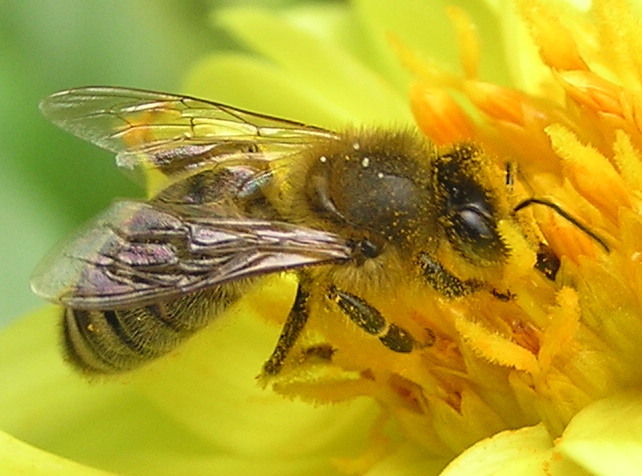
(image from: http://www.dereila.ca/whispers/HoneyBee3.jpg)


The Picnic Table Naturalist, Page 2 – Buzz

In his almanac-style journal, The Rural Life, Verlyn Klinkenborg writes about gardeners in early spring, calling them “ordinary mortals [that] find themselves nearly defeated by the gardening deadlines that pass so swiftly”. To this I can only add an amen, and consider further an earlier phrase he uses, “anxious pleasure”. Another word for this condition could be buzz; which is, in this case, a natural high.

The word buzz brings to mind both the early honey bee, just beginning his frenetic foray into all things blooming, as well as that fizzy, slightly vertiginous feeling one gets in their head from too much coffee, a hearty drag from a cigarette, or other such vices. My particular buzz-du jour comes from, as Klinkenborg alluded to, the harried pace of gardening preparation that is endemic to this time of year. Perusing the catalogs for those last-minute seeds or chemicals; sketching out the (soon-to-be ignored) new year’s schematic for the raised beds; fussing over the seedlings which seem to languish, then burst out all at once…this buzz comes over me: last week’s just happened to be brought on by the freshly-remembered idea of ground covers – “green fertilizer”, to those green thumbs out there – for this year’s garden.

There is a weird dichotomy at play here, though. On the one hand, I feel this spinning top of a drive in my gut and my head and hands, pulling me mind and body into the soil, and that gradually burgeoning milieu. However, as often happens in spring, I get ahead of myself, and allow my mind to overtake my hands – and then I end up running out of gardening tasks to take on, because I was in too much of a hurry. It’s a race against an indefatigable yet friendly rival: time. Learning to neither race ahead – succumbing to that buzz in our heads – nor lag behind – giving in too often to the slumber that “so easily entangles” in warm spring sunshine – are both crucial. A balance is necessary. And one important key I’ve found to maintaining that balance is to simply be in the garden. What better place to be, than in the very space where your plans will come into action, and make the most impact? Laying out a schematic bedding plan, and plotting when to best start seeds or order supplies: these are all preparations which fall roughly into the theoretical, or in the supporting role, if you will. The lead role is that of the garden itself, and if you stay in it, and breathe and feel it, it will be easier to maintain a balance, and not let that buzz spin us faster than is necessary. Bees of necessity need that hurried pace to keep up with what nature provides them...we, on the other hand, have (for better or for worse) groceries and commercial foods to make up for the slack in our gardening...or, as the year may turn out, the gardening makes up for the slack in the budget.

Spring, after all, is a time to savor and enjoy, and being in a garden is a valuable part of that. Gardening is a partnership or it is nothing – and a good partnership has a lot to do with good timing.

Read more...

Spring and the studio

Alright, time for another interlude of recent photos of studio work, etcetera.

Below you'll see what I've been working on this past weekend, and last evening. Along with cleaning out the entire backyard, pruning the grapes and apple trees, thinning the raspberries and strawberries, and installing a new rain-barrel, I began building some raised beds. Vicki and I have missed container gardening since we left the apartment, but also like having the extra space at the house, so we came to a compromise, and I've begun putting in these beds for my vegetables and herbs. Raised bed gardening, especially for "kitchen gardens", has a rich and long history, back to medieval Europe, and was particularly popular with Pennsylvania German farmwives, who favored the "four-square" layout (four square beds in a grid). Here, I am digging the post holes for the second bed, and below that you'll see the first bed, sans seat (which I began last night...I love these later-lit evenings).

Since Vicki took these pictures, I've decided to take a board off the top, making them a bit shorter. It would have taken too much soil to fill them, and about thirteen inches is plenty high. I'm hoping to pick up some free compost from Fairmount Park to fill much of the beds.


And of course seasons come and go, but I keep plugging away at the studio. I've already shown this painting on the blog, but that was before I added the little bit of colored strips curling off at the top. The working title is Cede. (The shot is a bit dark).


I also showed some shots of prescription slips I'd been painting different colors on both sides, but here is the finished piece, with the folded origamis-of-a-door papers affixed to a nice piece of Arches paper. As you can see it needs some flattening, but I'll be framing this for the house soon, I hope. Still working on a title for this one.


And, lastly, I have long had a fascination with flattened Chinese takeout boxes, and have approached them from many angles. Lately though I've had trouble getting into a drawing mindset, which is what I previously did with them, so I decided to just start painting on some I had sitting around. The drawing idea came after that. This particular one is in latex paint, marker and yellow enamel, and is based on the Forsythia which is just coming around again now.


Have a great Spring; next Art Thoughts coming right up.


Read more...
Related Posts with Thumbnails