Picnic Table Naturalist, Page 4: Overlap
>> Tuesday, August 11, 2009 –
honey bee,
insects,
overlap,
Picnic Table Naturalist,
summer
%2520%255BMO%252005%255D.jpg) (above, one of my favorite wasps, the mud dauber, or mud wasp)
(above, one of my favorite wasps, the mud dauber, or mud wasp)
Picnic Table Naturalist, Page 4 – Overlap
This is the season of the year when two worlds, normally oblivious of each other, collide: the worlds of the hapless humans and the intrepid insects. I’m particularly thinking here of those insects in the order Hymenoptera: flies, wasps, bees and ants, and all those other filmy-winged permutations such as bee flies; wasp-waisted bees, hornets, etc. A prime illustration of the generally vague animus between these two groups is the monikers given by most people to the entire body: “bees” or “flies” (that is, the ones without stingers, and the ones with). Most people wouldn’t associate ants with this group, so we'll leave them out for the sake of argument.
The grape arbor behind our house is on its last legs of dropping ripe fruit, and we’ve had a veritable motley crew of flies, bees and wasps coming through, many of which I don’t recognize, let alone know the name of, even after a rural childhood of growing up around them, and a lifetime of fascination with them. But by far the most numerous of these hymenoptera in our yard this summer have been what I call the green bottle fly, a medium-sized fly, bedecked in iridescent teal. My knowledge of fly biology is limited, but it seems a whole generation of these flies has hatched, matured, feasted, reproduced and subsequently expired, all on and around our arbor and deck. In fact, the undersides of our fig tree’s bottom leaves are coated with dead flies, clinging to the leaf in their rigor mortis, like so many raisins, or barnacles. And many of them also dangle in dead groups from fronds on our nearby asparagus plants, weighing them down like weird, black jewelry.
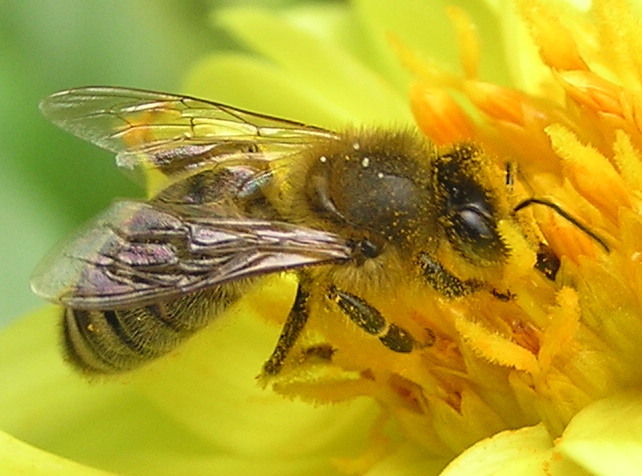
Most fascinating to me, though, and to my eye the most beautiful, are the various types of wasps that I see this summer. Because they are now reaching maturity in great numbers, and finding abundant ripening fruit, this fascinating group of creatures has begun overlapping with ours. And this overlap happens mostly because our favored late summertime activities coincide very closely with theirs: camping; picnicking; gardening and fruit harvesting…and generally being out of doors (their domain). Unfortunately, along with the common wrong designation of “bee” or “fly”, most people carry a disdain and even outright fear of any flying insect, even the most beautiful and yes, the most harmless, no doubt instilled by some adult’s naïve admonition, or that first painful sting from a bumblebee on little bare feet. In fact, many of the most threateningly large “bees” in our area are almost harmless to humans, and normally sting only when provoked. A prime example of a completely harmless wasp is the cicada killer, a large and magnificent wasp who cares simply for cicadas – nothing else. Even though they can get up to almost two inches in size, they are completely non-threatening…though impressive.
Of course, the ideal “overlap” of the layperson and the insect world is that of curiosity – of self-education; careful observation; common-sense conservation. When our interests and activities overlap in this way, without incident – and with even the occasional incident seen contextually – then those hymenoptera can be appreciated much more than they normally are. As most beekeepers will tell you, the sweet honey – and the interaction with a fascinatingly complex insect culture – is worth the occasional sting.
This is the season of the year when two worlds, normally oblivious of each other, collide: the worlds of the hapless humans and the intrepid insects. I’m particularly thinking here of those insects in the order Hymenoptera: flies, wasps, bees and ants, and all those other filmy-winged permutations such as bee flies; wasp-waisted bees, hornets, etc. A prime illustration of the generally vague animus between these two groups is the monikers given by most people to the entire body: “bees” or “flies” (that is, the ones without stingers, and the ones with). Most people wouldn’t associate ants with this group, so we'll leave them out for the sake of argument.
The grape arbor behind our house is on its last legs of dropping ripe fruit, and we’ve had a veritable motley crew of flies, bees and wasps coming through, many of which I don’t recognize, let alone know the name of, even after a rural childhood of growing up around them, and a lifetime of fascination with them. But by far the most numerous of these hymenoptera in our yard this summer have been what I call the green bottle fly, a medium-sized fly, bedecked in iridescent teal. My knowledge of fly biology is limited, but it seems a whole generation of these flies has hatched, matured, feasted, reproduced and subsequently expired, all on and around our arbor and deck. In fact, the undersides of our fig tree’s bottom leaves are coated with dead flies, clinging to the leaf in their rigor mortis, like so many raisins, or barnacles. And many of them also dangle in dead groups from fronds on our nearby asparagus plants, weighing them down like weird, black jewelry.
Most fascinating to me, though, and to my eye the most beautiful, are the various types of wasps that I see this summer. Because they are now reaching maturity in great numbers, and finding abundant ripening fruit, this fascinating group of creatures has begun overlapping with ours. And this overlap happens mostly because our favored late summertime activities coincide very closely with theirs: camping; picnicking; gardening and fruit harvesting…and generally being out of doors (their domain). Unfortunately, along with the common wrong designation of “bee” or “fly”, most people carry a disdain and even outright fear of any flying insect, even the most beautiful and yes, the most harmless, no doubt instilled by some adult’s naïve admonition, or that first painful sting from a bumblebee on little bare feet. In fact, many of the most threateningly large “bees” in our area are almost harmless to humans, and normally sting only when provoked. A prime example of a completely harmless wasp is the cicada killer, a large and magnificent wasp who cares simply for cicadas – nothing else. Even though they can get up to almost two inches in size, they are completely non-threatening…though impressive.
Of course, the ideal “overlap” of the layperson and the insect world is that of curiosity – of self-education; careful observation; common-sense conservation. When our interests and activities overlap in this way, without incident – and with even the occasional incident seen contextually – then those hymenoptera can be appreciated much more than they normally are. As most beekeepers will tell you, the sweet honey – and the interaction with a fascinatingly complex insect culture – is worth the occasional sting.
Read more...


 Posts
Posts